J. is following up on an investigation of funnels. He found this hole in the wire shelving and wished to investigate what would happen if he poured his water through it. He had a clear intention and plan on how he should observe this. He did it a couple of times but seemed to have a difficult time observing the results when he was concentrating on pouring it down the hole. So, I offered to pour it so that he could observe the results.
Because this was his idea, I asked him how I should do it. He carefully showed me and asked me to do it slowly. By allowing me to do the pouring, J. was able to change his perspective and adjust accordingly.

 As always, in the Wonder Studio, one person's inquiries leads others down the same path!
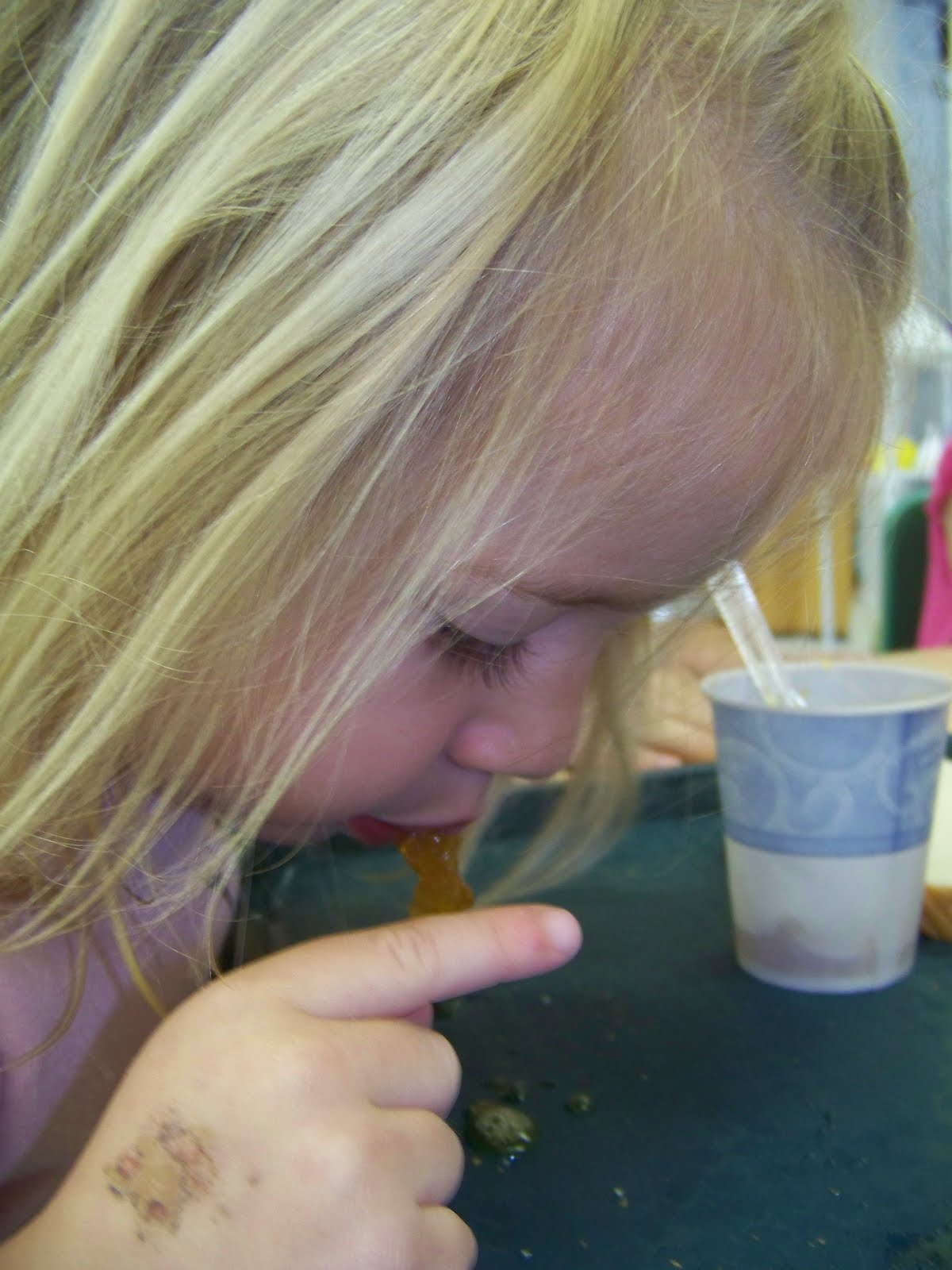
 A gorgeous honeycomb brought in by our wonderful Mom, Crystal! Thank you!! I tried to get many of the children's first reactions to this amazing taste!


Exploring Motion with a Pendulum
In the book, Constructive Play, by George Forman and Fleet Hill, the following is explained:
Younger children often throw the "ball" or in our case "froggy" instead of releasing it. Younger children tend to persist in this for a long time. They are still discovering the limits of the string on the movement of the "froggy". Younger children also tend to get in the way of the backswing of the ball, too. They might chase after the "froggy" not yet understanding that it would return to them if they stayed put.
This experience with the froggy pendulum is designed so that children will consider the perspective of their own body in space relative to an object.
These experiences offer many opportunities for parents to provide challenges for their child. An adult could set up the cups that are placed beyond the path of the froggy pendulum, so that it is impossible to hit them. Then observe how the child approaches this challenge. Do they walk away? Do they knock them over with their hands, do they move the target? Lots of different ways to approach this challenge!